Why do humpback whales breach and sing?
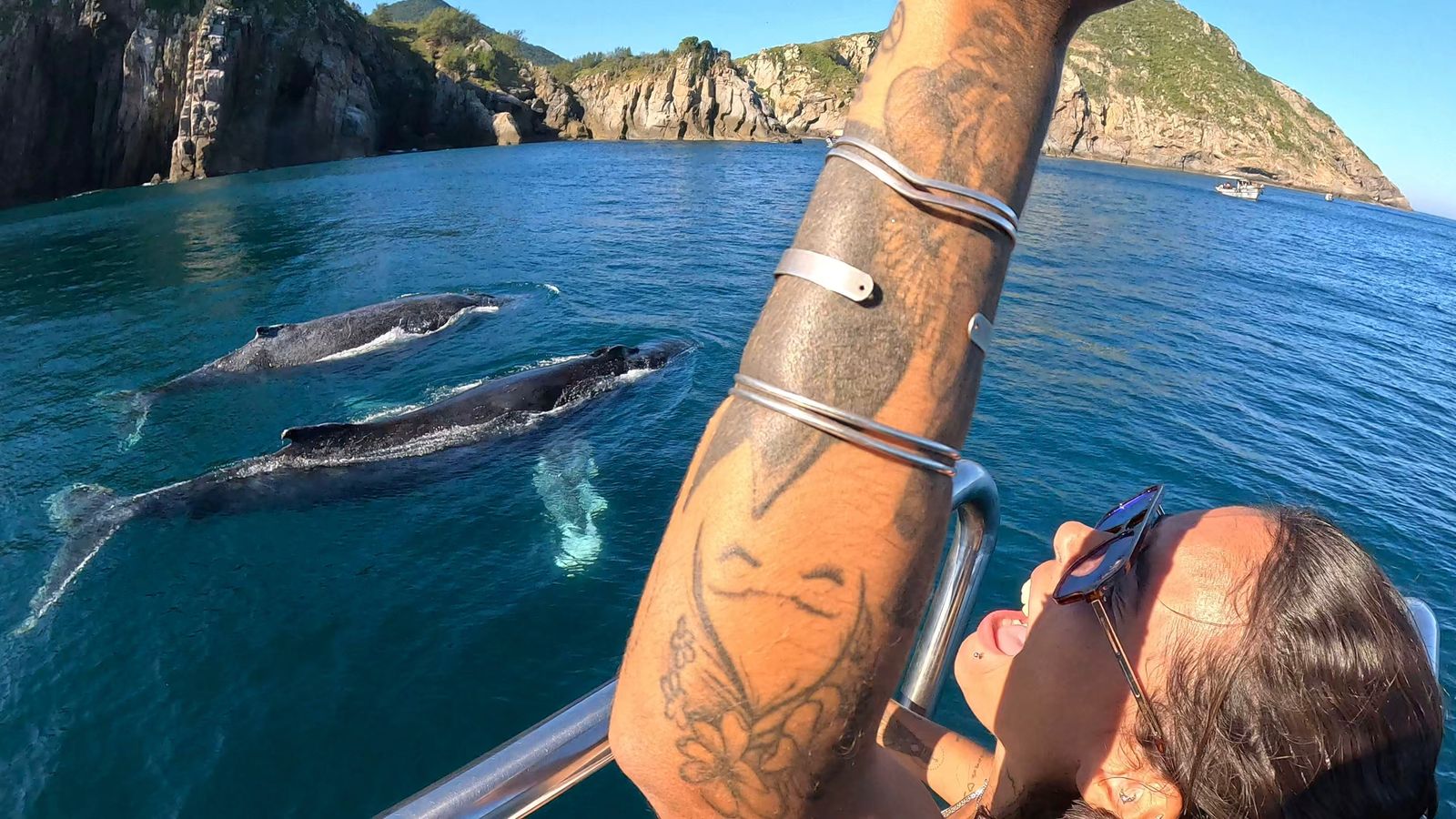
It is the question that comes up on the boat right after the first breach: why does it do that? The honest answer is that science has good hypotheses and no absolute certainty. It is worth knowing them before you come — they completely change what you see when a forty-tonne animal throws itself out of the water in front of you.
- Breaching has several plausible explanations: communication, courtship and shaking off parasites.
- Play is taken seriously as a hypothesis, but nobody can prove it.
- Only males sing, and the song travels long distances underwater.
- An adult humpback reaches 16 m and 40 t — a breach moves a lot of water.
- In Arraial, the season to watch it runs from June to September.
What a breach is
Breaching is when the whale throws most of its body out of the water and lands on its side or back. To put the effort in perspective: an adult humpback reaches 16 metres and around 40 tonnes (Projeto Baleia Jubarte). That is not a cheap movement. Which is why "why does it do that?" is a good question — no animal spends that kind of energy at random.
The hypotheses for breaching
There is no single accepted explanation. There are several, and probably all of them are right at different moments:
- Communication. Forty tonnes hitting the surface makes a sound that travels a long way underwater. It is a way of signalling position to other groups.
- Courtship and competition. In the breeding season, breaching is part of the display repertoire between males and towards females.
- Shaking off parasites. Humpback skin carries barnacles and other passengers; the impact helps get rid of them.
- Play. Yes, it is a serious hypothesis — especially in calves, which breach repeatedly with no obvious social context. It is also the one nobody can prove.
That is the interesting part: after decades of observation, the most spectacular behaviour of the species still has no closed answer.
The song: who sings and why
Humpback song is another chapter. It is the males that sing, in long organised sequences repeated for hours. The sound is low enough to travel great distances underwater — water carries sound far better than air, which is why acoustic communication pays off so well for an animal spread across an ocean.
Stranger still: the song has versions. Males in the same population sing the same "tune" in a given season, and it changes over the years, with new passages spreading through the group. It is cultural behaviour, transmitted rather than purely instinctive.
You will hear none of it from the surface. It is worth knowing it is happening anyway.
Not every movement is a breach
Much of what you see on a whale watching day is not a full breach, and each movement has a name and a function:
- The blow. Almost always the first sign: a column of vapour on the horizon.
- The tail going up. It means a deep dive — a humpback can stay under for up to 30 minutes (Projeto Baleia Jubarte). If the tail went up, get ready to wait.
- Slapping a fin or the tail on the water. Also makes sound, also communicates.
- The head out of the water. The animal looking around.
Telling them apart changes the day: instead of waiting for a breach that may never come, you start reading what the group is doing.
What you can watch in Arraial
Arraial do Cabo sits on the species' migration route, and the season runs from June to September, peaking in July. From land, Praia Grande works as a natural viewpoint on calm days — it is the beach 200 metres from the hostel. At sea, the whale watching boat trip brings you closer.
For the practical side of the season — dates, where to stay, how community-based tourism works here — our whale season guide covers it all.

Frequently asked questions
Why do humpback whales breach?
There is no single explanation. The most accepted hypotheses are communication (the impact makes a sound that travels far underwater), courtship and competition between males in the breeding season, and shaking parasites off the skin. Play is also considered, especially in calves, but it is not proven.
Do only male humpback whales sing?
Yes. The long organised song, repeated for hours, is male behaviour. The tune changes over the years within a population, which points to cultural transmission.
How long can a humpback whale stay underwater?
A humpback can dive for up to 30 minutes, according to Projeto Baleia Jubarte. When the tail comes clear of the water, it signals a deep dive — and a wait.
Can you see whales breaching from the beach in Arraial do Cabo?
On calm days, yes: Praia Grande works as a natural viewpoint during the season, from June to September. Watching from land depends on luck and a clear horizon; from a boat, the observation is closer.
How big is an adult humpback whale?
Up to about 16 metres long and around 40 tonnes, according to Projeto Baleia Jubarte.
Sources
- Projeto Baleia Jubarte — "A baleia jubarte" (size, weight, migration, diving). Accessed on 04/08/2026. baleiajubarte.org.br/a-baleia-jubarte
- Projeto Baleia Jubarte — "Conservação" (population status). Accessed on 04/08/2026. baleiajubarte.org.br/conservacao