Humpback Whale Season in Arraial do Cabo (2026)
Every winter the same scene plays out right in front of us. The sea wakes up glassy, someone points at the horizon, and there it is: a puff of spray, then a tail rising and vanishing. A humpback whale. We have lived in Arraial do Cabo since 2019, we run Massambaba Hostel 200 metres from Praia Grande, and from June to September this stops being a rare event and becomes routine. This guide gathers what we have learned watching the season up close, year after year.
The season runs from June to September, and July is the month we see the most whales right in front of us. Every year around 20,000 humpbacks pass the Arraial coast, one of the biggest concentrations in the country. You can watch for free from Praia Grande on a calm-sea day, or up close on the boat tour. One thing we'll ask: go with people who are local and trained. The good operators keep the 100-metre distance from the animals, and that's what keeps the encounter safe for both sides.
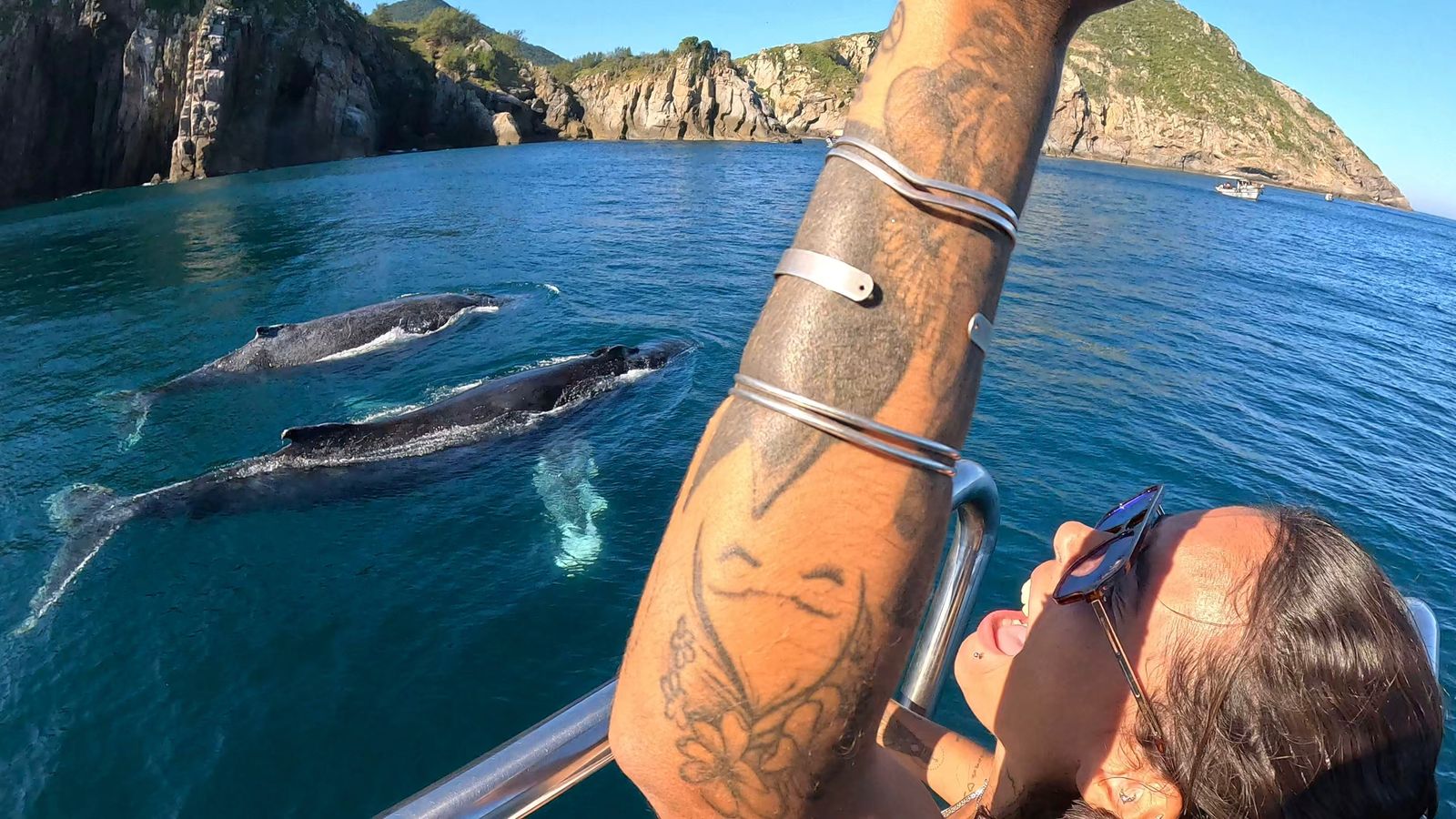
When is whale season in Arraial do Cabo?
Humpback whale season in Arraial do Cabo runs from June to September, peaking in July. In 2025 the town opened the season officially on June 6 (Arraial do Cabo City Hall, via Portal Multiplix). It is a calendar that repeats with little variation every year, because it follows the animals' migration, not the tourist trade.
June and July are the most generous months. That is when the migration concentrates, and sighting several groups on the same day stops being luck and becomes a reasonable expectation. August still delivers good encounters, and September closes the season at a more spaced-out pace.
It coincides with Arraial's winter: emptier town, lower prices, clear skies and a golden sunset. In other words, the best time to see whales is also one of the best times to enjoy the town without the crowds. It is no accident that people who know Arraial well often prefer to come at this time of year.
Why do whales pass Arraial do Cabo?
Around 20,000 humpback whales pass the coast of Arraial each season, which led the Instituto Baleia Jubarte to rate the town one of the best whale-watching spots in Brazil (via Portal Multiplix). The reason is geographic: Arraial sits right on the species' migratory route.
Humpbacks make one of the longest migrations on the planet. They leave the cold, rich waters of the South Atlantic and head north toward warmer seas to mate and nurse their calves, on a round trip of nearly 9,000 km (Projeto Baleia Jubarte). Arraial's rocky headland juts out to sea and brings that route closer to shore.
Add the upwelling (the cold currents that rise from the deep and turn the water so blue and clear), and you get a productive stretch of sea, with good visibility and heavy whale traffic. The same geography that makes Arraial's water unique is what puts the humpbacks so close to the beach.
Community-based tourism: who takes you to the whales
In Arraial, whale watching is increasingly tied to community-based tourism: a model led by the local community itself, one that values the culture, history and knowledge of people who have always lived off the sea. In June 2025, the Marine Extractive Reserve of Arraial do Cabo launched, with ICMBio, the Sustainable Community Tourism Project, aimed at strengthening the local economy and expanding work opportunities.
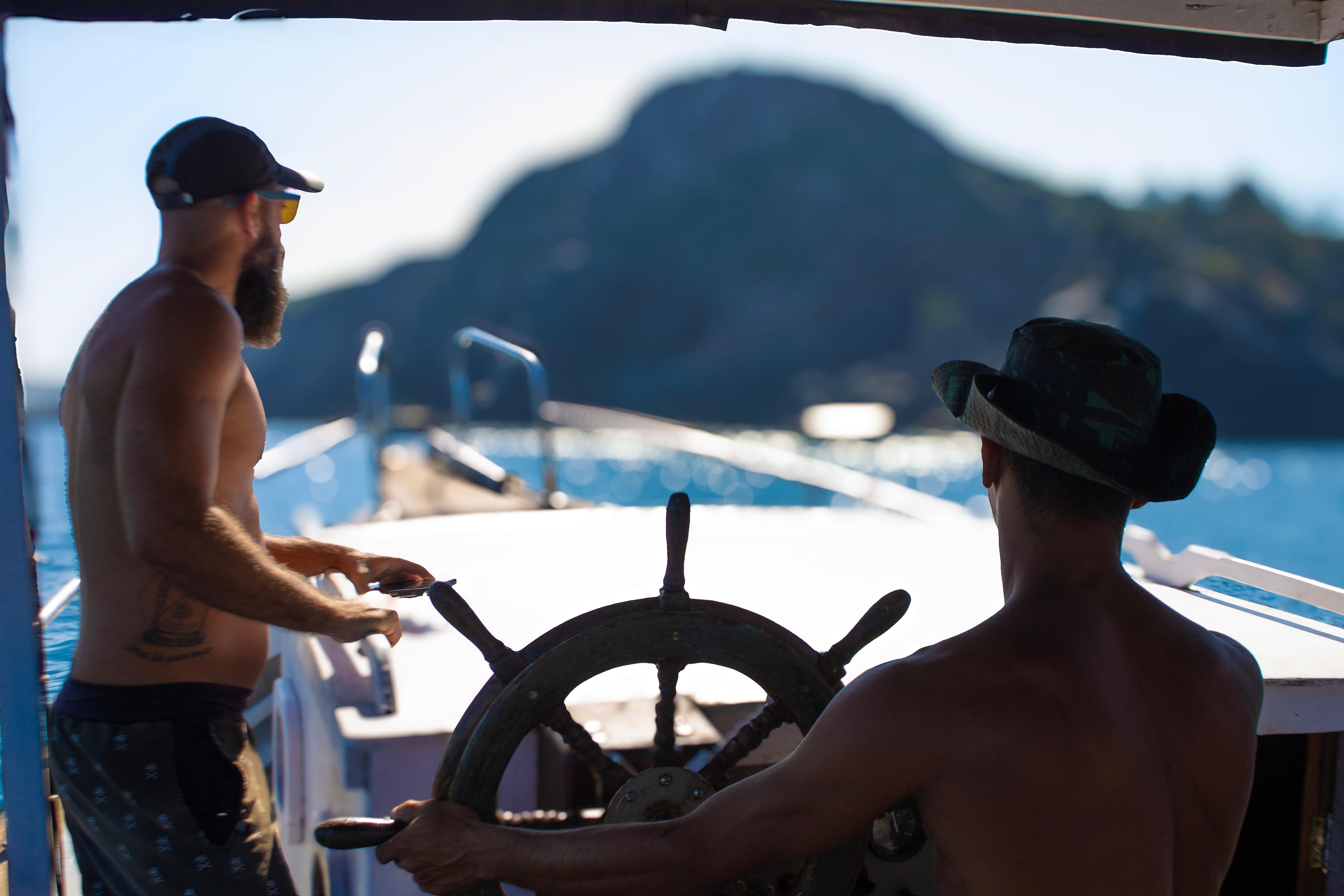
In practice, this changes who is at the helm. Instead of an anonymous reseller, you sail with residents and fishers who know the humpbacks' route by heart, can read the sea, and have a direct stake in protecting what sustains their own community. The knowledge that becomes an itinerary did not come from a manual: it came from generations watching this horizon.
This is where certified operators like Arraial Ecoturismo come in, working with trained professionals authorized to operate in the reserve while keeping a safe distance from the cetaceans. Their watching departures reach around 90% sighting rates, thanks to the town's privileged position on the migratory route (Arraial Ecoturismo).
At Massambaba, our everyday departure sails with the @e.missmayra boat, a direct partner of the hostel, with snorkelling included and departure from Praia dos Anjos. For whale season specifically, we help each guest choose an accredited operator. What matters is that the tour is safe for you and for the humpbacks.
Where to watch whales: Praia Grande or a boat tour?
You can watch whales for free, from the sand. On calm days, Praia Grande and the Pontal do Atalaia lookout work as natural box seats: with a little patience and a pair of binoculars, dorsal fins and breaches appear on the horizon. It is not guaranteed the way it is at sea, but it is free and, in July, it surprises you often.
The boat tour is a different scale of experience. From the water, the closeness changes everything: you hear the blow, watch the whole tail rise, sometimes follow a female with her calf. The skipper knows the sighting spots and adjusts the route when there is a whale in the area. And the same tour still delivers the islands, the snorkelling, and the beaches you can only reach by sea.
Want to understand the route, the timings and what to bring? The boat tour page covers it all. And the best time to visit guide puts whale season in the context of everything else the town offers.
Who is the humpback whale?
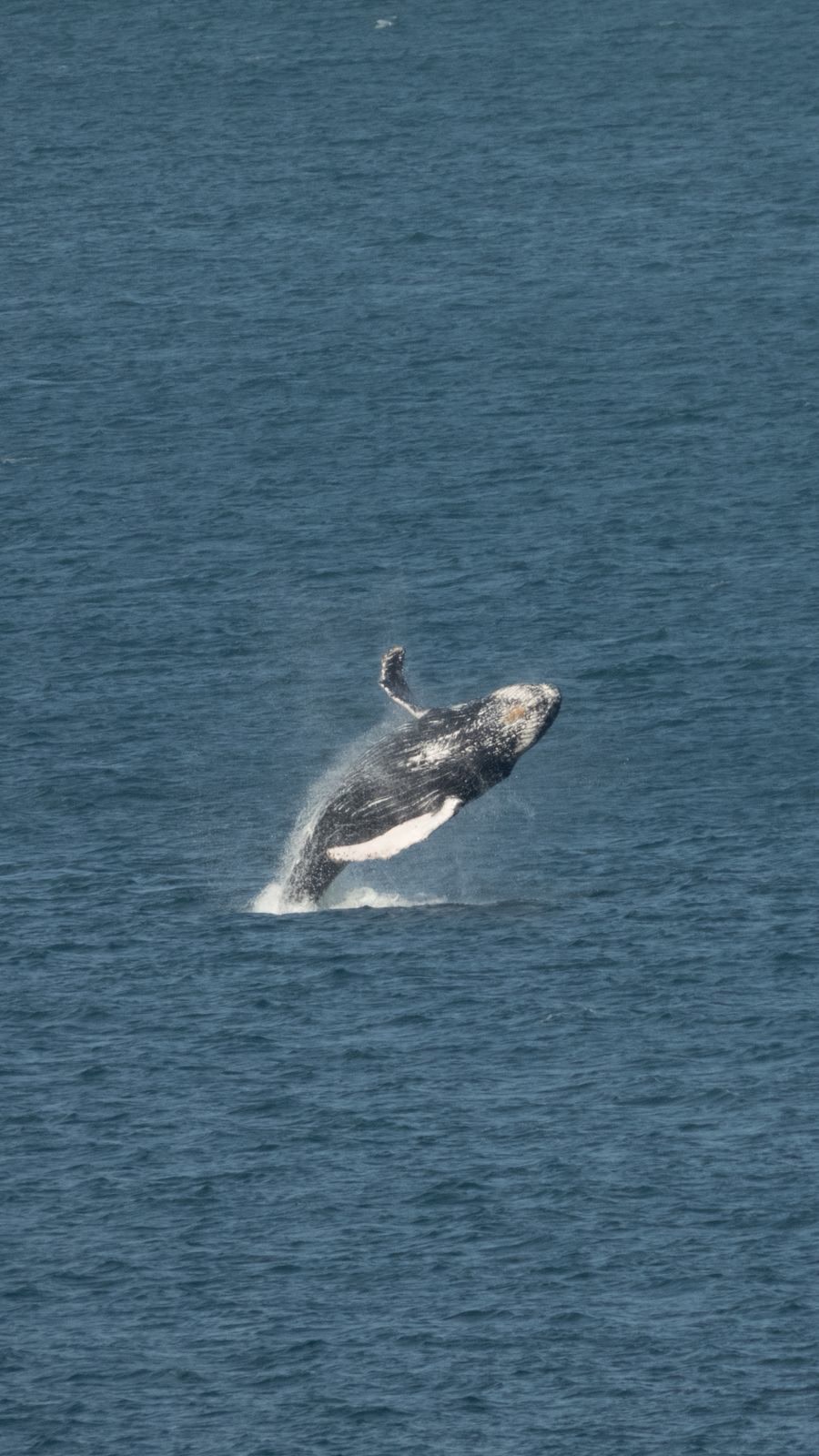
The humpback (Megaptera novaeangliae) can reach up to 16 metres in length and weigh around 40 tons (Projeto Baleia Jubarte). Its pectoral fins are the largest in the animal kingdom in proportion: they reach up to a third of the body length. That oversized "arm" is what names the species: Megaptera means "great wing".
It is also the most acrobatic whale. The humpback leaps clear of the water, slaps its tail on the surface and holds a fin up in the air, behaviours nobody fully explains, and which make it the star of any sighting. Each individual has a unique pattern under its tail, like a fingerprint, letting researchers identify animals one by one.
Underwater, the humpback dives for up to 30 minutes and descends more than 600 metres (Projeto Baleia Jubarte). Males produce the longest, most complex "songs" in the animal kingdom, sequences that repeat for hours and change from season to season. When one passes near the boat, it is hard not to feel the sheer size of it.
From hunting to admiration: the return of the humpbacks
That there are 20,000 whales to watch today is, in itself, a recovery story. An estimated 300,000 humpbacks were killed by commercial whaling in the South Atlantic before the international bans (Projeto Baleia Jubarte). The Brazilian population was reduced to a fraction of what it had been.
When conservation work began, in the late 1980s, around 1,000 animals remained off the Brazilian coast. Today there are more than 30,000, a figure approaching what is estimated to have existed before whaling (Projeto Baleia Jubarte). In 2014, the species was removed from Brazil's National List of Endangered Species.
Here is the connection we like to draw: Arraial do Cabo was once a land of fishing and whaling industry. The same town that once lived off taking from the sea now lives, in part, off showing it intact. The turn from hunting to admiration is not only the whales' story: it is Arraial's too. And community-based tourism is its most recent chapter.
Approach rules (and why a good guide matters)
Whale watching in Brazil follows clear rules: boats must keep a minimum distance of 100 metres from the animals and may not cut in front of them or chase groups (IBAMA). It is not red tape: it is what keeps the encounter from turning into stress or an accident for the whale, especially when calves are present.
That is why choosing an operator with trained guides makes a real difference. A good skipper cuts the engine at the right moment, holds the distance, and lets the whale decide whether to come closer. Often it does, out of curiosity, on its own time. Community-based operators working under the reserve's rules have exactly this care built into their training.
Practical tips for whale season
- Morning tours: the sea is usually calmer early, which helps both the sailing and the sightings. In the afternoon the wind picks up and the sea gets choppy.
- July is the surest month: if you can pick the date, aim for the peak. But June and August also deliver good encounters.
- Bring a warm layer: it is winter and it is windy at sea. A windbreaker makes a difference even on a sunny day.
- Binoculars help on land: to watch from Praia Grande or the Pontal do Atalaia, a simple pair of binoculars transforms the experience.
- Keep your dates flexible: if the sea turns, the tour will not go out, and that is a good thing. Leave a spare day in your plan to reschedule.
- Book with an accredited operator: confirm that the guides are trained and authorized to work in the reserve. Just ask; there is nothing wrong with that.
- Combine it with the rest: the season overlaps Arraial's low season. Enjoy the quiet town. See the best time to visit.
Frequently asked questions about whale season
When is humpback whale season in Arraial do Cabo?
It runs from June to September, peaking in July. In 2025 the season opened officially on June 6 (Arraial do Cabo City Hall). Humpbacks migrate up from the South Atlantic toward warmer breeding waters, and Arraial sits on the route, which makes it one of the best whale-watching spots in Brazil.
Where can you watch whales in Arraial do Cabo?
From land, Praia Grande and the Pontal do Atalaia work as natural viewpoints on calm days. At sea, a boat tour brings you safely closer. Around 20,000 whales pass the region each season, according to the Instituto Baleia Jubarte.
How do you choose a responsible whale-watching tour?
Choose operators with certified, trained guides who are authorized to work in the reserve and respect the 100-metre minimum distance from the animals. Serious community-based operators, such as Arraial Ecoturismo, follow these rules and work with local residents who know the whales' route.
What are the chances of actually seeing a whale?
High in season, especially in July. Certified operators report around 90% sighting rates on watching departures, thanks to Arraial's position on the migratory route (Arraial Ecoturismo). No tour guarantees 100%: these are wild animals. But the odds at the peak are excellent.
How big is a humpback whale?
It can reach up to 16 metres and weigh around 40 tons (Projeto Baleia Jubarte). The pectoral fins reach up to a third of the body, and it dives for up to 30 minutes, more than 600 metres deep.
Sources
- Projeto Baleia Jubarte — "A baleia jubarte" (size, weight, migration, diving). Retrieved 2026-07-11. baleiajubarte.org.br/a-baleia-jubarte
- Projeto Baleia Jubarte — "Conservação" (population recovery, removal from the endangered list). Retrieved 2026-07-11. baleiajubarte.org.br/conservacao
- Portal Multiplix — "Arraial do Cabo opens the 2025 Whale Season" (June 6, 2025 opening, ~20,000 whales, best spot in Brazil). Retrieved 2026-07-11. portalmultiplix.com
- ICMBio / RESEX-AC — Sustainable Community Tourism Project (launched Jun 2025). Retrieved 2026-07-11. gov.br/icmbio
- Arraial Ecoturismo — "Whale watching in Arraial do Cabo" (community-based, trained guides, ~90% sighting rate). Retrieved 2026-07-11. reservas.ondaarraial.com