Remote work in Arraial do Cabo: what it is like to work from Massambaba Hostel

Every week someone walks in with a laptop under their arm and asks the same thing: “can I work from here?”. The honest answer is yes, and well, as long as you know what you are getting. Massambaba is not a coworking space with a sea view. It is a house full of plants, 200 metres from Praia Grande, with a dedicated work room away from the common area and a big table where the 8am breakfast turns into an office by 9am. This post explains how it really works, what we do to help, and what we cannot promise.
- A remote-work room separate from the common area: table, chairs, outlet and books. Quiet during the day.
- Free WiFi across the hostel; the common area has the big table, the counter and the light from the big window for those who prefer company.
- Quiet hours from 10pm to 8am and a common area open 24h — guests only.
- For video calls, the private suite is the best option; in a dorm, headphones are the rule.
- Praia Grande is 200 metres away: you can slip out between two meetings and be back in 40 minutes, and clock off with the sunset in the backyard.
- In 2024, 6.6 million Brazilians worked from home (IBGE) — and home can be here for a week.
Why work from a hostel in Arraial do Cabo?
In 2024, according to IBGE's PNAD Contínua household survey, 6.6 million Brazilians worked from home — 7.9% of private-sector workers, still above the pre-pandemic level (IBGE, Pesquisa Nacional por Amostra de Domicílios Contínua, released November 2025). The question those people ask is no longer “can I work from home?” but “from which home?”.
Arraial do Cabo is about 170 km from Rio. Close enough to arrive on a Friday and leave on a Monday, and far enough for the sea to be a different one: cold, clear, full of life. For remote workers that means a week where the lunch break is a swim and the 5pm meeting ends with the sun dropping behind the hill.
What makes Massambaba different is two things. The first is a dedicated remote-work room, just for working, which we show below. The second is the house. The common area is an urban jungle: plants hanging from the ceiling, a big window that lets light and wind in all day, a wooden table that seats eight. In the morning it is the breakfast table, mantras included. From 10am it is the desk of whoever stayed in. We have watched it happen every day since 2019: breakfast ends, the plates go, the laptops come out.
We are small on purpose. 25 guests at most, in five rooms. That changes everything for anyone who needs to focus: the common area never turns into a party, and the team knows the name of whoever is working there, and who is on a call.
The remote-work room: a space just for working
Besides the common area, Massambaba has a separate room designed for remote work. It sits away from the breakfast and kitchen traffic, which changes everything: it is the one room in the house where nobody walks behind your screen. It has a round table, chairs, a wall outlet and a shelf with books and travel guides. Natural light during the day, and quiet.
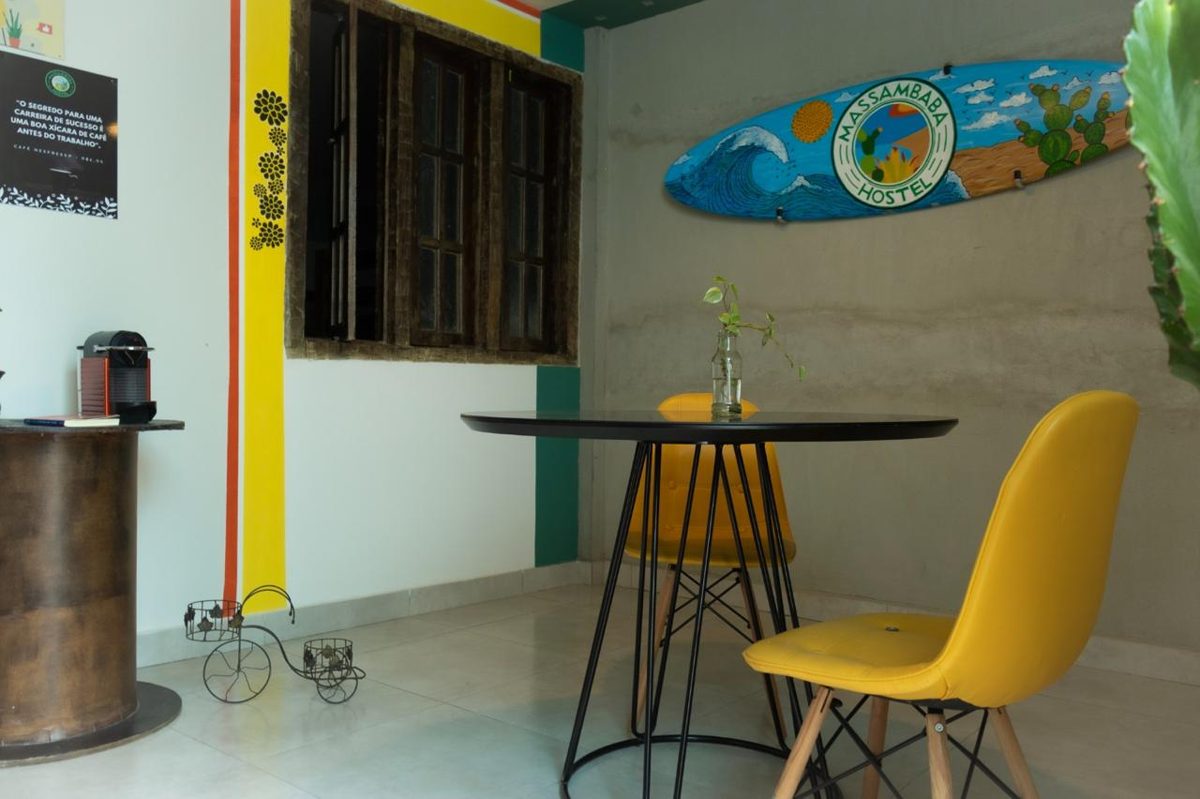
We keep the room tidy and lean: the table is always clear, nothing stored on it, chairs in place, one light over the table. That is not an aesthetic choice, it is a practical one. Whoever sits down opens the laptop in thirty seconds instead of spending the first ten minutes pushing things aside. The rule is the same as in the kitchen: leave it as you found it, so the next person can open their laptop in thirty seconds too.
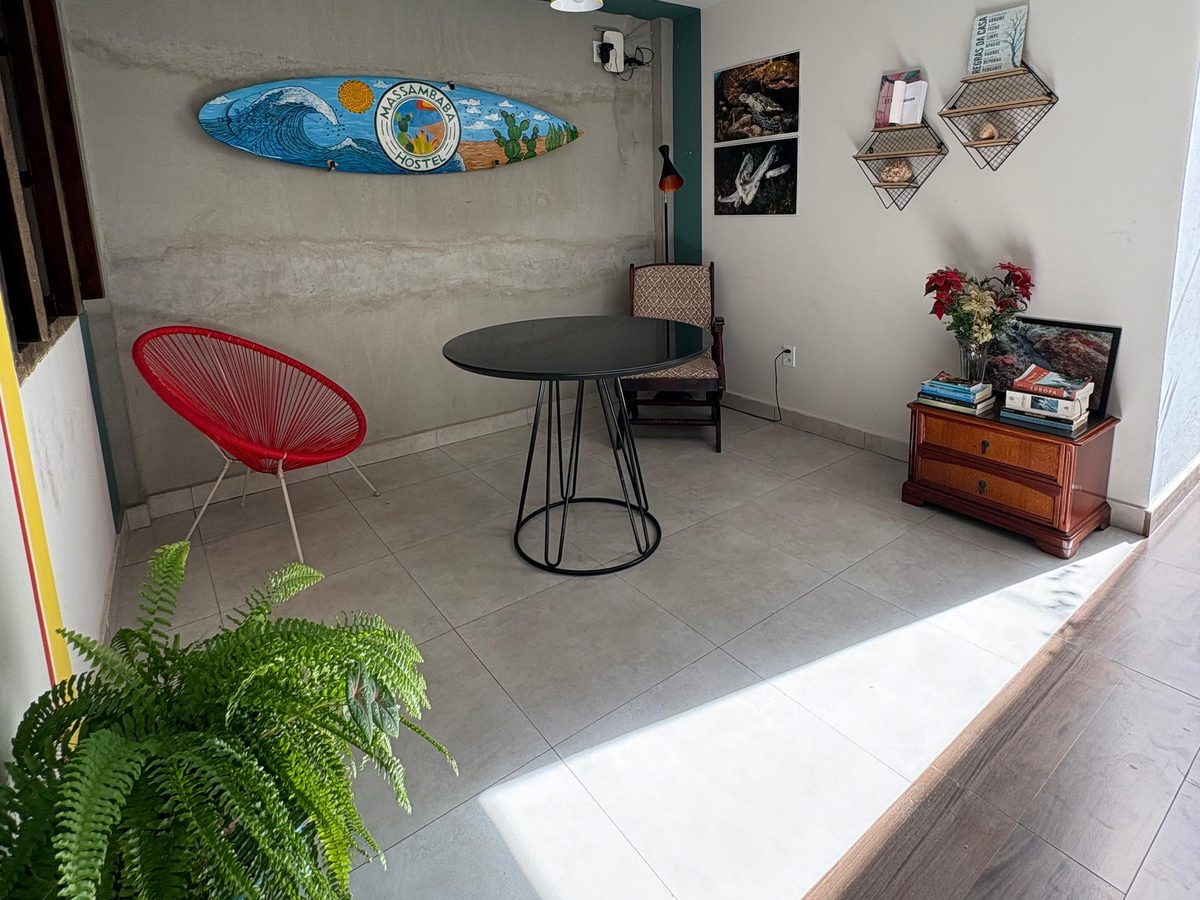
And it is this room that makes possible what most places only promise: escaping to the beach in the middle of the day. From the chair to the sand at Praia Grande is 200 metres, about three minutes on foot. A meeting ends at 11 and the next one is at noon? That is time for a swim, drying off in the sun and getting back to the table with a clear head. We see it every day: the laptop stays open in the room, the towel hangs on the door, and the person is back before the screensaver kicks in.
What else does the hostel have for working: table, WiFi, outlets, quiet?
Outside the room, here is the inventory, no frills. WiFi is free and covers the whole hostel: common area, kitchen, rooms and bathrooms. The common area is open 24 hours, guests only, with quiet hours from 10pm to 8am. Rooms have air conditioning and an individual outlet at every bed. Every guest has a locker with a key for the laptop when heading to the beach.

2. The counter — tall stools under the skylight. Light from above, good for anyone who wants to stand up now and then.
3. The hammocks and beanbags — for reading, answering email and reviewing a document. Nobody writes a report from a hammock, but everybody tries.
There is a fully equipped kitchen (stove, microwave, fridge, filtered water) open from 8am to 8pm. In practice that means you do not have to go out for lunch if you are in the middle of something. Breakfast runs from 8am to 10am and is included in the rate.
One thing we decided not to do: we do not publish a Mbps figure. We have measured it, and the number changes with the time of day and how many people are connected. A pretty number on the page and a bad afternoon in real life is the kind of promise we do not want to make. If your work depends on guaranteed bandwidth, message us on WhatsApp before booking: we run a test on the spot and reply with the real number for that day.
What does a remote-work day at Massambaba look like?
What we see most, after five years watching people work from here, is a routine that follows the sun. Nobody invented it: it is what happens when the beach is 200 metres away and the house goes quiet at 10pm.
| Time | What happens |
|---|---|
| 7am | Anyone who wants an empty sea goes before breakfast. Praia Grande in the morning is a different beach. |
| 8–10am | Breakfast with mantras at the big table. The busiest moment in the common area — do not schedule a meeting here. |
| 10am–1pm | The work room and the big table turn into an office. The quietest block of the day: anyone not working has already left for the beach or the boat. |
| Between meetings | A 40-minute gap in the calendar becomes a swim at Praia Grande. It is 200 metres: 3 minutes there, 3 minutes back. |
| 1–2pm | Lunch. Kitchen open, or 200 metres to a kiosk on the sand. |
| 2–5pm | Second block. Strong sun outside, good light inside. Calls are better with headphones. |
| Late afternoon | Clocking off, by house law: sunset in the backyard. Nobody works during that half hour. |
| 10pm–8am | Quiet hours. If you need to work on another country's time zone, it is in the common area, with headphones. |

One detail that makes a difference: we read the wind forecast every morning at breakfast for those heading out. Remote workers use the same information the other way round: a day of strong SW wind is a day to close deliverables; a day of light NE wind is a day to get up early, go out on the boat and work in the afternoon. Our post boat or beach explains how to read it.
Which room should you choose for working?
It depends on how many calls you take. The rule we give on WhatsApp fits in three lines:
- Private suite — for anyone with lots of video meetings. A door that closes, air conditioning, private bathroom, outlet. The only option where the call does not depend on anyone else.
- Budget private room — a double room with a door, shared bathroom in the washrooms. Fine for short calls and for anyone who wants to sleep without people coming into the room.
- Dorm (mixed or female) — for anyone who works in the work room or the common area and uses the room only to sleep. Every bed has an outlet and a locker with a key. Calls in the dorm, never: house rule.
Prices and availability for your dates are on the rooms and prices page. For a full week of work, the suite tends to be the choice of anyone who has tried doing it from a dorm once. But with the remote-work room, the dorm has started working for a lot of people: sleep in the room, work in the work room.
What does not work (so you are not disappointed)
Better to read this here than to find out at check-in.
What we promise in return: a small house, with people who know your name, and a sea that changes colour every day two minutes' walk away. For a lot of people that is a good trade. For anyone who needs an office, better we say so now.
Can foreigners work remotely from Brazil?
We host a lot of people from Argentina, Chile, the United States and Europe who work while they travel. For them, worth knowing: since January 2022 Brazil has a specific digital nomad visa, the VITEM XIV, created by Normative Resolution No. 45 of the National Immigration Council (Ministry of Justice, Immigration Portal, Practical Guide for Digital Nomads).
The main requirements: proof of a minimum income of US$1,500 per month or funds of US$18,000, and a link to an employer or clients outside Brazil. The visa is valid for one year, renewable for one more. For a short stay — one or two weeks — most nationalities enter as tourists and work remotely without any issue; the XIV visa is for anyone who wants to stay for months.
If you are arriving from abroad, our guide on how to get to Arraial do Cabo explains the route from Rio's airports.
When to come and work in Arraial?
For working, the best time is the one tourists avoid. From March to June and from August to November the town empties out, the common area gets quieter and the sea stays the same: cold and clear. December, January, Carnival and long weekends are the opposite: full house, full beach and high-season prices. Our best time to visit guide shows what changes each month.
Remote workers have an advantage the weekend tourist does not: they can come Tuesday to Tuesday. Weekdays here are a different town, and the big table is all yours.
Frequently asked questions
Does Massambaba have a coworking space?
There is a dedicated remote-work room, separate from the common area, with a table, chairs, a power outlet and books, always kept tidy. It is not a coworking space with booths: it is shared with other guests who are working. Beyond it, the common area has the big table and the counter. Free WiFi across the hostel and quiet hours from 10pm to 8am.
Can I take video calls at the hostel?
Yes. The best spot is the remote-work room, separate from the common area and quiet during the day. Since it is shared with other guests, use headphones. For long or confidential calls, the private suite and the private room are the best options.
How fast is the WiFi at Massambaba?
WiFi is free and covers the whole hostel. We do not publish a Mbps figure because it changes with the time of day and how many guests are connected. If your work depends on guaranteed bandwidth, message us on WhatsApp before booking: we run a speed test on the spot and reply with the real number for that day.
Can foreigners work remotely from Brazil?
Yes. Since 2022 Brazil has a digital nomad visa (VITEM XIV), regulated by Normative Resolution No. 45 of the National Immigration Council (CNIg). It requires proof of a minimum income of US$1,500 per month or US$18,000 in funds, plus a link to an employer or clients outside Brazil. It is valid for one year, renewable for one more.
Which room is best for working?
The private suite, if you take a lot of calls. It has air conditioning, an outlet, a private bathroom and a door that closes. The dorm works for people who work in the remote-work room or the common area and use the room only to sleep: every bed has its own outlet and a locker with a key.
Sources
- IBGE — PNAD Contínua, remote work module 2024: 6.6 million people working from home, 7.9% of private-sector workers. Released via Agência Brasil, November 2025. Retrieved 2026-09-18. agenciabrasil.ebc.com.br
- Ministry of Justice and Public Security — Immigration Portal, “Residence permit for digital nomads in Brazil: practical guide” (CNIg Normative Resolution No. 45/2021). Retrieved 2026-09-18. portaldeimigracao.mj.gov.br
- Ministry of Foreign Affairs — Temporary Visa XIV, Digital Nomad (VITEM XIV). Retrieved 2026-09-18. gov.br/mre
- House rules, opening hours and facilities of Massambaba Hostel as per the guest manual (updated August 2026) and the team's observation since 2019.